Supporting industrial growth with resilient infrastructure
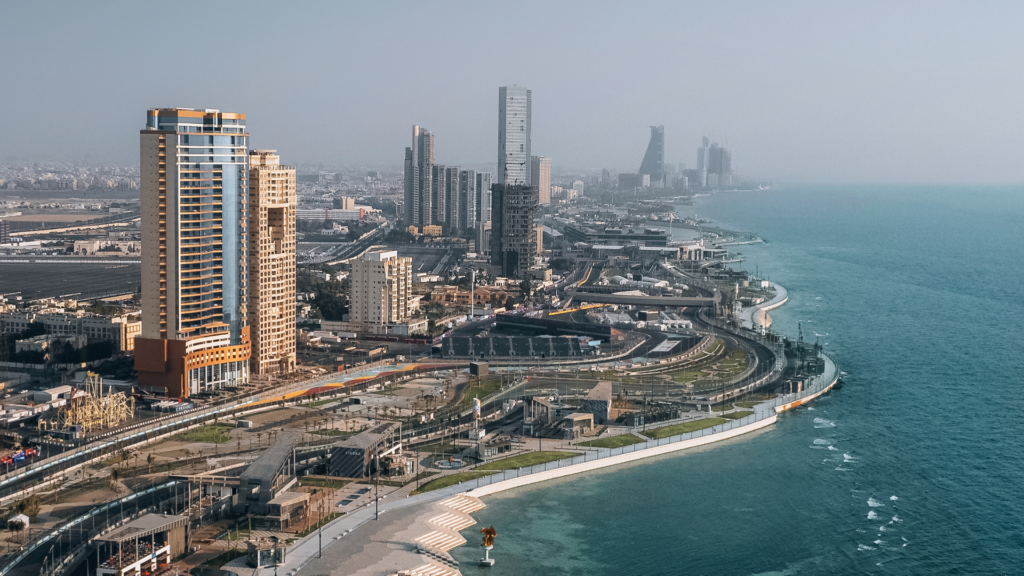
Located in Jeddah, near the Red Sea, the project serves the second and third industrial cities, a rapidly expanding economic zone hosting hundreds of factories and thousands of jobs.
The scale of operations reflects the ambition of the project:
- 273 km of water and wastewater networks;
- Drinking water, sewer and treated effluent systems;
- Pumping stations and storage infrastructure;
- Industrial wastewater treatment capacity reaching 10,000 m³/day, with future expansion up to 40,000 m³/day.
This infrastructure ensures reliable service delivery to industrial users while supporting the region’s economic development.
Turning wastewater into a resource
One of the most innovative aspects of the joint venture lies in its full reuse model for treated effluents.
Initially, the industrial wastewater treatment plant remained underutilized due to the absence of a reuse outlet. Tawzea Aquapor addressed this challenge by designing and implementing a complete reuse solution, enabling:
- Irrigation of green areas within the industrial city;
- Reduction of freshwater consumption;
- Elimination of wastewater transport to distant disposal sites.
This approach embodies a circular model where no water is wasted, contributing both to environmental sustainability and operational efficiency.
Driving circular economy and environmental performance
The benefits of this model are significant:
- Preservation of scarce drinking water resources;
- Reduction of environmental footprint;
- Creation of greener industrial environments;
- Improved resilience to water stress.
By transforming treated wastewater into a valuable resource, the project aligns with broader sustainability objectives, including the Saudi Green Initiative, which promotes reforestation and environmental protection across the Kingdom.
Smart services and operational excellence
Beyond infrastructure, Tawzea Aquapor delivers a wide range of services designed to optimize performance and reliability:
- Preventive maintenance of water networks;
- Non-invasive inspection of sewer systems using advanced CCTV technologies;
- Digital tools for billing, customer management and water delivery.
These capabilities enable a data-driven and proactive approach to water management, ensuring long-term efficiency and service quality.
Contributing to the future of sustainable cities
The joint venture also supports large-scale development projects such as NEOM, where it provides integrated water management services adapted to next-generation urban environments.
This involvement highlights the strategic role of water services in shaping sustainable, resilient and innovative cities.
A model for sustainable water partnerships
Tawzea Aquapor illustrates how international collaboration can deliver tangible impact on the ground: combining technical expertise, local knowledge and long-term vision to address one of the most pressing challenges of our time, which is water scarcity.
By integrating infrastructure, reuse, digitalization and environmental performance, the joint venture offers a replicable model for sustainable water management in industrial and urban contexts worldwide.
Because building the cities of tomorrow starts with securing the resource that makes everything possible: water.